
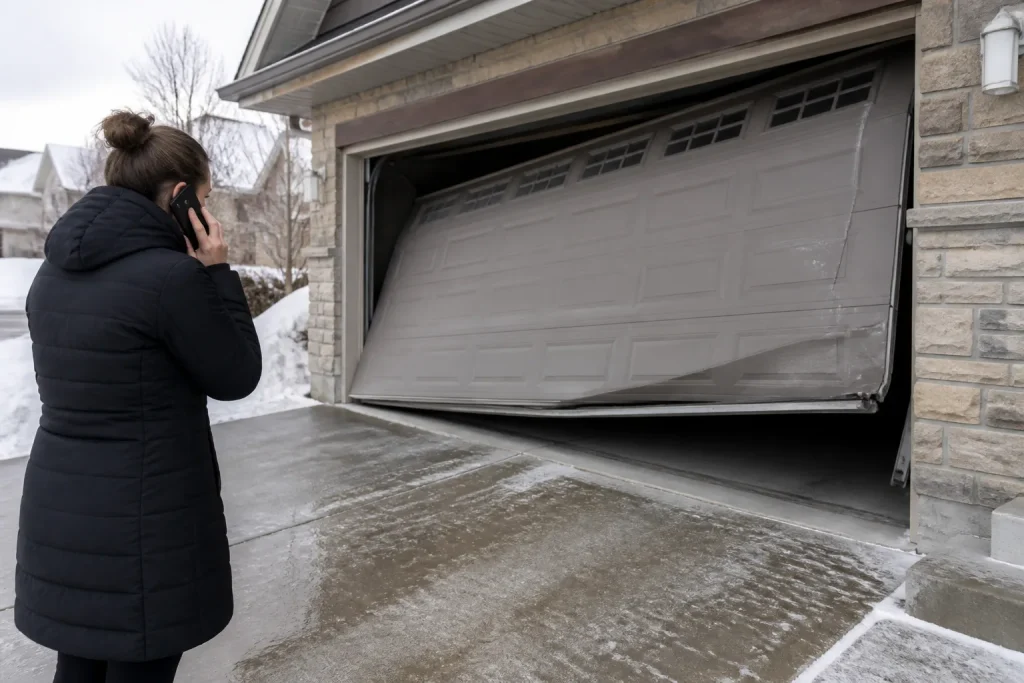
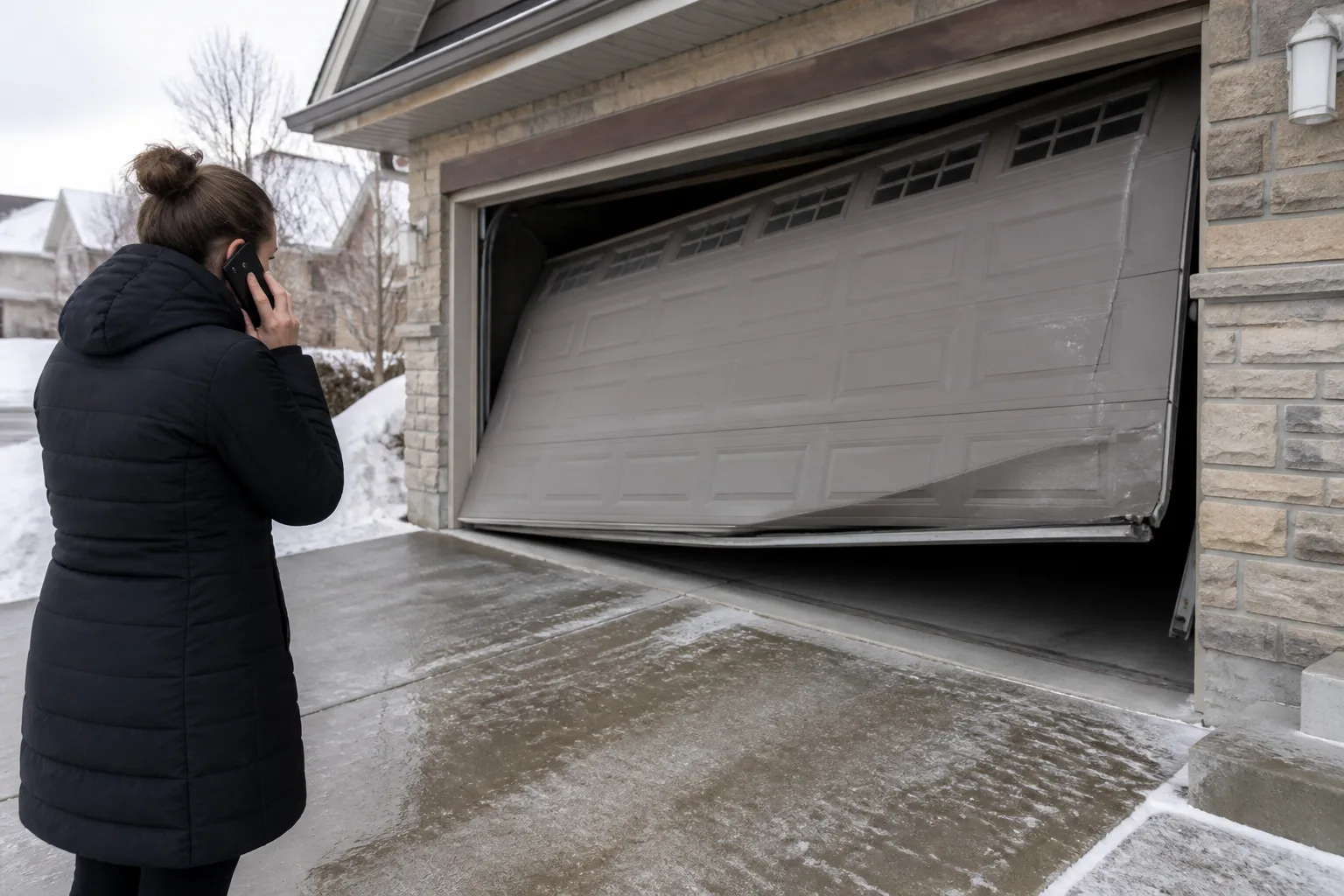
Emergency Garage Door Near Me: What Denver Homeowners Should Do First
If your garage door just failed and your car is trapped, start with this: don’t call the first number that appears. Run a 60-second visual check on the springs, cables, and tracks, write down what you see, and only then call a contractor who will put the price in writing before a truck rolls. If you’d rather skip the triage and talk to someone now, call (970) 725-6025.
The Federal Trade Commission has cited garage door “emergency” dispatchers in sting operations across seven states. The playbook rarely changes: a $29 dispatch fee, a technician who arrives and finds four “additional failures,” and a card run before you’ve seen a written quote. Denver, with its cold-snap spring failures and attached garages on nearly every block, is exactly the kind of market these operations target.
This guide walks through what to check before you call, how to verify whoever answers, and what a fair after-hours price actually looks like in Denver. Cut the average overcharge exposure by knowing the vocabulary and the numbers before you’re standing in a dark driveway at 10 p.m.
The Haven family of ten home-service brands sees this pattern across every trade: the emergency call is when homeowners pay the most for the least information. This guide exists because what homeowners actually complain about is not workmanship but not knowing.
Key Takeaways
- Four failure types are safely identifiable without special tools or training.
- Colorado’s DORA license lookup takes under four minutes and filters out the worst actors.
- Three specific phrases signal a predatory dispatcher: ‘special spring,’ ‘lifetime cable,’ and ‘same-day warranty fee.’
- Realistic Denver after-hours pricing: $225-$425 for a torsion spring, $175-$325 for a cable, $250-$450 for a bent track.
- Every legitimate emergency quote should be in writing before work begins, not after the door is off the ground.
The 60-Second Triage: What You Can Safely Diagnose Before Calling
Your garage door just made a sound like a gunshot, or it stopped halfway up, or the opener is running but the door isn’t moving. Before you call anyone, take one minute and look at four things. This information changes the phone call entirely, because it tells the dispatcher whether you need a $45 cable or a $400 spring assembly, and it tells you whether the person on the other end is being straight with you.
1. The spring. Look up at the torsion spring above the closed door, the horizontal coil on the metal shaft. If it’s snapped into two pieces with a visible gap, that’s a broken torsion spring. This is the most common failure in Denver, usually after a cold snap contracts the metal. If the spring is broken, stay out of the garage entirely until the technician arrives. The stored tension in a torsion spring is enough to seriously injure anyone standing nearby when it releases or when the door is forced open. Do not try to open the door, and do not stand under it. Let the professional handle this one.
2. The cables. Look at the two cables running along each side of the door. In Denver’s dry climate, cables fray more slowly than in humid regions, but they still snap under uneven load or after years of rust. A snapped cable looks like a loose wire hanging from the drum or a cable that’s jumped off the roller entirely.
3. Opener vs. door. Pull the red emergency release cord hanging from the opener rail. Try to lift the door manually with one hand. If it’s heavy and won’t move, the door itself has a problem (spring, cable, track). If it’s light and moves, the problem is the opener. Openers fail differently than doors, and the repair path is entirely separate.
4. Track debris. Look at the vertical and horizontal tracks. Denver’s spring winds blow grit, leaves, and an impressive amount of gravel into garage tracks, especially in neighborhoods like Stapleton and Green Valley Ranch where newer construction still has exposed soil. A rock in the track stops a door mid-travel and often gets misdiagnosed as a spring failure.
We pulled a small boulder out of a track in a house over in Washington Park last year. The homeowner had been quoted $600 by a dispatch service before calling us. The rock came out with a flathead screwdriver and the door ran fine for another year.
Verify a Denver Garage Door Contractor in Under Four Minutes
Colorado makes this easier than most states. The Department of Regulatory Agencies (DORA) maintains a license lookup that resolves any credential in seconds. Here’s the sequence:
- Ask for the contractor’s license number on the phone. A legitimate Denver garage door company will rattle it off without pausing.
- Go to the DORA licensing lookup and enter the number. If it doesn’t resolve to a matching business name, hang up.
- Check the classification. Colorado requires an Electrical license for any work that touches the opener’s wiring or motor logic. Mechanical work on springs, cables, and tracks does not require a state credential, but that’s where bond and insurance verification matters.
- Ask for proof of bond and general liability. In Denver, a $10,000 bond is a common floor for door companies. If they can’t produce documentation, assume the worst.
Here’s a detail most guides miss: when you look up a Denver door contractor on DORA, expand the “Disciplinary Actions” field. Colorado publishes complaints that have moved through adjudication. A clean record isn’t everything, but a pattern of consumer complaints tells you exactly what this company does at 10 p.m. when you’re not looking.
What if the number doesn’t resolve? That’s a hard stop. Unlicensed operators count on the fact that you’re cold, tired, and your car is trapped. The verification step takes four minutes. The average after-hours overcharge in Denver is $300 to $600.
Three Phrases That Signal a Predatory Emergency Dispatcher
The FTC stings found the same vocabulary in every state. These phrases are engineered to sound technical and scary while justifying an inflated invoice. Here’s what they mean and how to answer each one.
“Special spring.” A dispatcher tells you your door has a “special spring” that costs more. Here’s the truth: garage doors use two spring types, torsion (mounted above the door) and extension (mounted along the sides). Neither is “special.” Torsion springs are common in Denver on doors built after 2000. Extension springs are common on older Arvada and Lakewood homes. Both are standardized parts with published price ranges. The counter-question: “Is it torsion or extension, and what’s the spring rating?” If they can’t answer, they’re not a technician.
“Lifetime cable.” This phrase is pure upsell. There is no such thing as a lifetime cable. Cables are galvanized steel or stainless steel; the latter lasts longer but costs about $15 more per side. The honest upgrade is stainless, not “lifetime.” If you hear “lifetime cable,” ask for the manufacturer and part number. The line usually goes quiet.
“Same-day warranty fee.” This one is a flat $150-$250 surcharge disguised as a guarantee. A legitimate warranty is included in the repair price, spelled out in writing, and does not carry a separate line item. The Haven Standard’s 365-Day Done Right Promise, for context, is not a surcharge. It’s a clause: if it’s not done right, it’s made right, for a year. No fee attached.
Every Haven brand is held to the same five clauses, whether the job is a locksmith call or a full ADU build. The price is on the page - in dollars - before anyone arrives.
Realistic After-Hours Pricing in Denver: The Numbers to Know
Before you stand in your driveway evaluating a verbal quote, know what the work actually costs in Denver. These ranges reflect the local market, factoring in the union-scale labor base, the cost of stocked parts, and the normal after-hours premium.
| Repair | Typical Denver Range (After Hours) | Reasonable Vet Check |
|---|---|---|
| Broken torsion spring | $225-$425 | Ask for the spring rating and whether both springs are being replaced (they should be, in pairs). |
| Snapped cable | $175-$325 | Ask if the pulleys and drums are being inspected as part of the service. |
| Bent track | $250-$450 | Ask if the track is being repaired in place or replaced; bends in the vertical section often require replacement. |
| Opener motor or board | $200-$400 | Ask if the failure is the board or the motor; opener replacement is a separate conversation. |
Any quote more than 40% above these ranges deserves a hard question: “Why?” In Denver, the cold-snap spring rush in February and March pushes prices to the top of the range. October through January, when doors get less stress, prices sit at the floor. If a dispatcher quotes $800 for a torsion spring in October, it’s not the market. It’s them.
One more thing: the price should be quoted and agreed before any work starts. Clause 1 of the Haven Standard exists because this is the exact moment when a homeowner’s judgment is most compromised. A written price, in dollars, before the technician touches the door. That’s not a premium service. It’s the baseline for any legitimate operation.
What a Haven Standard-Compliant Emergency Call Includes
This section is a benchmark, not a sales pitch. When you call any of the ten Haven brands for an emergency in Denver, the dispatch protocol includes five things that should be universal but aren’t.
Clause 1: The price in writing before work starts. Every home-service brand under the Haven family publishes its price range on the page, in dollars, before any van is dispatched. ‘Call for a quote’ is not a Haven practice and contradicts Clause 1.
Clause 2: A real arrival window with a named technician. You get a window and a name before they arrive, not a four-hour “sometime today” and a mystery contractor. For emergency garage calls in Denver, where timing matters because your car is trapped, a named technician changes the accountability.
Clause 3: Licensed, insured, and background-checked crews. The license number is on the page. Not just “licensed and insured” as a phrase. The actual number.
Clause 4: Photographic evidence of what was found. Every Haven visit includes photos of what the technician saw, what they did, and what it looked like before. In an emergency repair, this is the difference between a believable invoice and a story you take on faith.
Clause 5: No upsell at the door. The price was agreed before the truck left. Nothing gets added because the technician is already there and your car is already out of commission.
Ten home-service brands. One standard. That’s the family-level architecture. The local Denver garage door brand under Haven operates like any independently owned and operated business, with a truck, a crew, and relationships in Cherry Creek or Highland. But the five clauses are non-negotiable.
What happens when you call
- 1
A real person answersNo phone trees - you reach a local pro.
- 2
You get an upfront price rangeHonest numbers before anyone is dispatched.
- 3
A background-checked tech heads outLicensed & insured, dispatched right away.
- 4
You approve before work beginsNothing starts until you say go.
When to Call a Pro
The 60-second triage above is designed to give you information, not to put a socket wrench in your hand. Three situations call for professional help immediately:
- A broken torsion spring. The stored energy in a torsion spring is the most dangerous part of any residential door system. Denver door technicians train for years to handle these safely. This is not a DIY repair under any circumstances.
- A door off its tracks. A door that has jumped the horizontal track can fall. The panels weigh 150-300 pounds. That’s a crush injury waiting on the wrong move.
- Any failure involving the opener’s electrical wiring. If you see exposed copper, a burnt control board, or a motor that sparks, this is an electrical hazard on top of a mechanical one. Licensed pros only.
If you’re in Denver and need help, Garage Door in Denver covers assessment, repair, and emergency response. We also handle Gate Repair in Denver and Chimney Cleaning in Denver if the emergency exposes a second trade. And if you’re comparing brands at the family level, start at Haven home.
The Bottom Line
An emergency garage door failure in Denver is manageable if you bring information to the phone call. Check the springs, cables, tracks, and opener before you call. Verify the license on DORA. Recognize the three upsell phrases for what they are. Know the real price ranges before you hear a verbal quote. And hold the line on written pricing before work starts.
We’ve been in this trade long enough to know that the quiet part is embarrassing: most emergency overcharges work because the homeowner doesn’t know the difference between a $45 part and a $400 assembly. Now you do. If you’re in Denver and need help, Haven offers free estimates - call (970) 725-6025.
Frequently Asked Questions
Do a 60-second visual check of the springs, cables, tracks, and opener. If the torsion spring is broken, stay out of the garage and do not attempt to open the door. Write down what you observe, then call a contractor who will put the price in writing before dispatch. Call (970) 725-6025 for a free estimate.
After-hours repairs in Denver typically run $225-$425 for a broken torsion spring, $175-$325 for a snapped cable, and $250-$450 for a bent track. If a quote lands more than 40% above these ranges, ask for the spring rating or part number and verify the technician’s DORA license.
Ask for the license number, then run it through Colorado’s DORA license lookup. Contractors doing opener work need an Electrical classification. Check the “Disciplinary Actions” field. Confirm bond and insurance documentation. If the number doesn’t resolve, don’t proceed. Every Haven brand publishes its license number on the page as part of Clause 3.
No. Torsion springs store enormous tension and release it without warning. Denver technicians train specifically for spring replacement. Extension springs are less dangerous but still carry significant risk. This is a professional repair, not a weekend project. Call (970) 725-6025 and the fix will be handled by a licensed, background-checked technician.
Written by the team at Haven, serving Denver since 1998.
Need Garage Door Help?
Call Haven - licensed & insured, here with fast after-hours help in Los Angeles.
(970) 725-6025