
Craftsman Garage Door in Denver: A Homeowner’s Guide
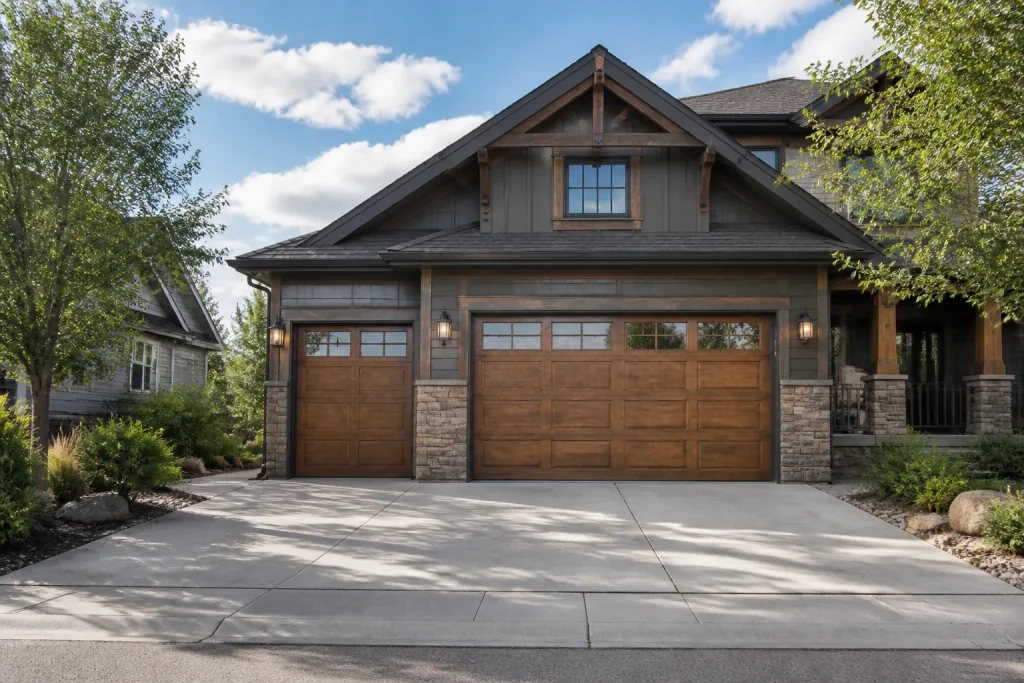
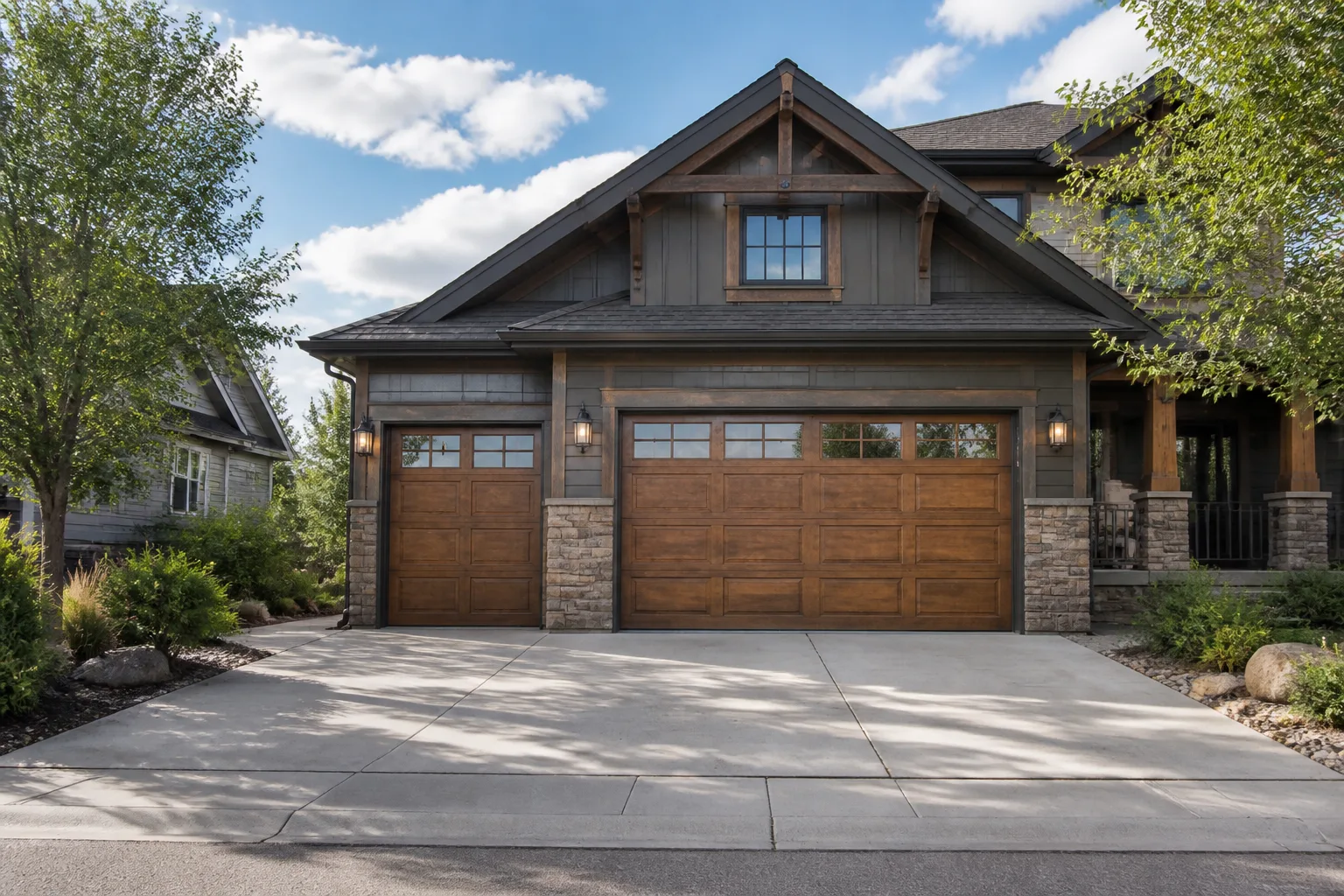
A Craftsman garage door in Denver is a statement about proportion: wide stiles, deep recessed panels, and hardware that looks like it belongs on a 1912 bungalow, not a spec box. But at 5,280 feet with 300-plus days of sun and clay soil that shifts seasonally, the wrong material choice turns that statement into a maintenance bill within three years. Here’s the spec-level guide that most national buying content skips, written for Denver homes specifically. If you’d rather skip the research and get a written price range on the page before anyone visits, call (970) 725-6025.
The Denver-Specific Problem: UV Load and Clay Soil
Denver gets more annual sunlight than Miami. That’s not a tourism slogan; it’s a material-science problem for any wood or wood-composite garage door facing west or south. Untreated clear-grain fir and hemlock, the traditional Craftsman panel species, absorb UV at roughly twice the degradation rate that manufacturer warranties assume when the door sits at altitude without shade. We’ve pulled five-year-old fir panels from west-facing garages in Washington Park and Platt Park where the south stile had faded three tones lighter than the north edge and the bottom rail had started lifting at the grain line. The warranty said “natural weathering.” The homeowner’s HOA said “repaint or replace.” The fix was a $1,700 refinish, not a warranty claim.
Then there’s the soil. Denver’s expansive clay moves with moisture cycles, and a slab that shifts a half inch seasonally puts uneven pressure on the door’s lower section and weather seal. A rigid wood Craftsman door on a shifting slab will show panel joint stress at the bottom-right or bottom-left corner within two winters. Steel-overlay Craftsman panels flex more before they fail, and a good installer will shim the track and check the bottom seal gap against the slab’s high point, not the average. Most national buying guides never mention slab shift because most national writers have never stood in a Denver garage in March after a freeze-thaw cycle and watched the daylight gap under a door that passed inspection four months earlier.
Material | Denver longevity expectation | Maintenance interval at altitude
- Clear-grain fir (stained) | 8-12 years before panel joint stress or fading | Restain every 2-3 years; reseal edges annually
- Hembus or wood-composite (factory-finished) | 12-18 years with edge sealing | Re-touch factory finish every 4-5 years; inspect panel seams each spring
- Steel embossed Craftsman overlay (Wayne Dalton or Raynor) | 18-25 years | Wash twice a year; check for hail dings after every spring storm
That table is the single most useful thing on this page. Print it. The materials all look similar from the curb on day one, but they diverge sharply by year five in Denver’s specific climate.
HOA Covenants and Historic District Overlays: Pull the Approval Form First
Denver has more than 50 designated historic districts and local landmark overlay zones, and within those zones, a garage door is treated as a primary character-defining feature, not a maintenance item. That means the Landmark Preservation office in Denver can require specific hardware finishes, panel profiles, and stain ranges before you order anything. We’ve seen homeowners in the Baker Historic District order a beautiful $4,100 custom fir Craftsman door with black strap hinges, only to discover the design review committee required satin bronze hardware and a specific divided-lite glass configuration. The door was denied. The order was non-refundable. The homeowner now had a $4,100 door in a crate and a manual approval process still ahead of them.
Even outside historic districts, many Denver HOAs enforce covenant tiers that restrict garage door materials. Common restrictions: “wood or wood-composite only” for Craftsman-designated neighborhoods, “no raised panel profiles” on modern overlay zones, and “stain color must be within the approved palette.” The approved palette is usually a three- or four-swatch document you can request from the management company before you shop, and it’s often defined by a footnote in the original plat, not a reasonable conversation with a board member.
Pull these before ordering:
- Your HOA’s architectural review form (usually a one-page PDF from the management company)
- Your subdivision’s covenant or design-control document, specifically the section titled “Garage Doors”
- Denver Landmark Preservation form, if your parcel falls in a designated district or overlay
- The finish hardware allowance: strap hinge color, clavo head style, handle finish
- Glass lite configuration allowance: divided-light patterns versus single glazing
If you order before you pull the form, the door gets denied. If you pull the form and read the fine print, the approval usually clears in two weeks. The Haven Standard’s Clause 4 requires photographic evidence of what a technician finds on every visit, and that documentation has saved more than one HOA dispute before it escalated to a board hearing.
Authentic Versus Builder-Grade: The Three Hardware Details That Decide It
A Craftsman door reads as authentic or fake within one second, and the three details that decide it are not the ones most people notice consciously. They’re the ones that hit the eye before the brain can explain why.
Strap hinges. Authentic Craftsman strap hinges are long, often 14 to 18 inches, mounted on the face of the stile with visible fasteners. Builder-grade versions use short, decorative-screw hinges that look like jewelry. From the curb, the long hinge reads as structural; the short one reads as applied. If the hinge does not extend at least one-third the width of the panel stile, it’s decorative.
Clavos. The nail-head ornaments along the stile edges. Authentic clavos are cast iron or bronze with a rounded, slightly irregular head. Stamp-pressed aluminum clavos read as cheap from 35 feet. Denver’s dry climate helps here: cast clavos will last decades, while painted steel versions will rust at the fastener edge within three years of freeze-thaw exposure.
Handle placement. On an authentic Craftsman door, the pull handle sits at the meeting stile on the lock side, not centered on the middle panel. Centered handles read as modern and neutral; offset handles read as period-correct. It’s a one-inch decision that changes the entire composition.
We’ll say it plainly: if a Denver builder offers you a Craftsman door upgrade for $400 over standard, it’s almost certainly the stamp-pressed version with short hinges. That’s fine if what you want is the suggestion of Craftsman. But if you’re in a neighborhood where the original 1920s homes set the standard, the suggestion version will look wrong by the second year.
What a Real Craftsman Install Should Document in Denver
Most Denver garage door installs are completed in a day, and most homeowners get a receipt and a handshake. The Haven Standard requires more, and knowing what that documentation should contain helps you evaluate any contractor, including a Haven garage door brand.
A complete Craftsman install record in Denver should include:
- Panel plumb tolerance. The door should be measured with a level at both side jambs and recorded. In a Denver garage on shifting clay, a door that’s out of plumb by more than a quarter inch should be corrected, not shimmed into place and left.
- Bottom seal gap spec. The seal should be measured against the slab’s highest point, not the average. A gap of more than 3/16 inch at any point along the width means the seal will not hold against Denver’s spring wind and dust.
- Spring balance certification. The door should be tested at halfway open position and balanced within a quarter turn. Doors that are over- or under-sprung by more than that will wear the opener, pull the track, and fail early.
- Photographic evidence. Before and after photos of the panel seams, the bottom seal, the spring assembly, and the hardware mounting points. You should walk away with these, not have to ask for them.
If a contractor cannot or will not hand you this record, that’s useful information. The work might still be fine, but you’ll never know what was measured and what was skipped. Clause 4 of the Haven Standard exists because we believe a homeowner should never have to ask for proof of what was found on their own property. The license number is on the page. The photo is in the report. The price was agreed before the work started.
When to call a pro: If your Craftsman door is sagging at the open position, the bottom seal shows daylight, or the panel joints have separated more than 1/8 inch in the last year, this is beyond a DIY tune-up. Springs are under high tension and should never be adjusted by a homeowner. A trained technician can diagnose the underlying cause, document it, and quote the repair in writing before any work begins.
Related services in Denver: Haven’s family of brands covers Garage Door in Denver and Gate Repair in Denver, plus Chimney Cleaning in Denver under the same five-clause published standard. If you’ve used one Haven brand, you already know what to expect from the next one.
Realistic Denver Pricing for Craftsman Doors
The national range for a Craftsman garage door installed is $1,800 to $4,200 for a standard two-car opening. Denver sits at the top of that range, and here’s why: the market discount for steel embossed panels is offset by demand for wood and wood-composite in the city’s Craftsman-dense neighborhoods, where the aesthetic is part of the property value. Independent supply houses in Denver typically price a Wayne Dalton wood-composite Craftsman door at $2,400 to $3,300 installed, a Raynor steel embossed Craftsman at $1,800 to $2,600 installed, and a custom clear-grain fir door from a local mill at $3,600 to $5,000 installed depending on glass lite configuration.
Those are real numbers from Denver-area suppliers, not national averages. The labor is comparable across materials. What varies is the panel cost and the finish schedule at altitude. A custom fir door in Denver needs its first restain at year two or three regardless of installer, and that restain runs $400 to $800 if you hire it out. The steel embossed door needs none of that for fifteen-plus years. So the true first-five-year cost of the fir door in Denver is the purchase price plus one restain cycle, which often erases the difference between it and the composite.
The Haven Standard’s Clause 1 requires the price in writing before work starts. That means a page with dollar figures, not a voice that says “we’ll have to come out and see what you’re working with.” If a contractor won’t name a range on the phone or on their site, you’re not getting a quote; you’re getting a sales visit. Our experience across Denver is that the reputable independents all quote in writing before dispatch, and the ones who don’t are charging by the square foot of your confusion.
And one thing that never changes across the Haven home family: the price is on the page, in dollars, before anyone arrives. Ten home-service brands. One standard.
The Bottom Line
A Craftsman garage door in Denver is a $1,800 to $4,200 architectural decision that most national buying guides treat as a $900 cosmetic one. The UV load, the clay soil, the HOA covenant, and the hardware details are Denver-specific variables that determine whether your door looks authentic in year seven or embarrassing in year three. Pull your HOA approval form before you order. Choose wood-composite or steel-overlay unless you want the restain schedule. Demand a plumb measurement, a seal gap spec, and a spring balance check as part of the install record.
If you’re in Denver and need help, Haven offers free estimates with the full price range quoted in writing before you schedule anything. Call (970) 725-6025 and a live person answers, 24/7, no automated queue between you and the trade.
Frequently Asked Questions
A Craftsman garage door in Denver typically costs $1,800 to $4,200 installed for a standard two-car opening, with steel embossed panels at the low end, wood-composite in the middle, and custom clear-grain fir at the top. Denver sits at the upper end of national pricing because of demand for wood aesthetics in Craftsman-density neighborhoods and higher finish labor at altitude. Call (970) 725-6025 for an exact quote in writing before any work starts; estimates are always free.
Yes, untreated fir and hemlock Craftsman panels warp and fade faster in Denver than manufacturer warranties assume because Denver gets 300-plus days of sun annually and sits on expansive clay that shifts slabs seasonally. West- and south-facing doors show visible panel joint stress and sun-fading within three to five years. Wood-composite panels resist this better, and steel embossed panels eliminate the problem almost entirely. For a door that will hold up against Denver UV, wood-composite is the safer material choice.
Many Denver HOAs and historic district overlays restrict Craftsman door hardware finishes, stain colors, and glass lite configurations, especially in designated districts like Baker or Curtis Park where the door is considered a character-defining feature. Pull your HOA’s architectural review form and your covenant’s design-control section before ordering anything. A door denied during design review is not a warranty issue; it’s an avoidable $2,000 to $4,000 mistake.
Same-day installation is generally not realistic for a Craftsman door because the door is measured, ordered, and often custom-finished before install, which typically runs two to four weeks from order to completion in Denver. What a reputable installer can do same-day is measure, quote the price in writing, and schedule the install. Call (970) 725-6025 and a live person will walk you through timeline and price before any work starts.
Written by the team at Haven, serving Denver since 1998.
Need Garage Door Help?
Call Haven - licensed & insured, here with fast after-hours help in Los Angeles.
(970) 725-6025